
Contents10 sections ↓
Series Roadmap: SuiteWorld 2026
SuiteWorld 2026 Announcements: What You Can Use Today
NetSuite SuiteSkills: What They Are and How to Use Them
Ask Oracle Connectors: NetSuite as an MCP Client, Explained
SuiteWorld 2026 Product Keynote: What Works Today
How to Roll Out Ask Oracle in NetSuite: A Plan in Four Steps
The second SuiteWorld 2026 keynote, "Ready for Now", ran on Tuesday, October 27, in Las Vegas. Brian Chess, NetSuite's SVP of AI, Product, and Technology, hosted it. Monday's opening keynote was about where NetSuite is going. This one had a single promise, repeated after almost every demo: everything shown is available in NetSuite today.
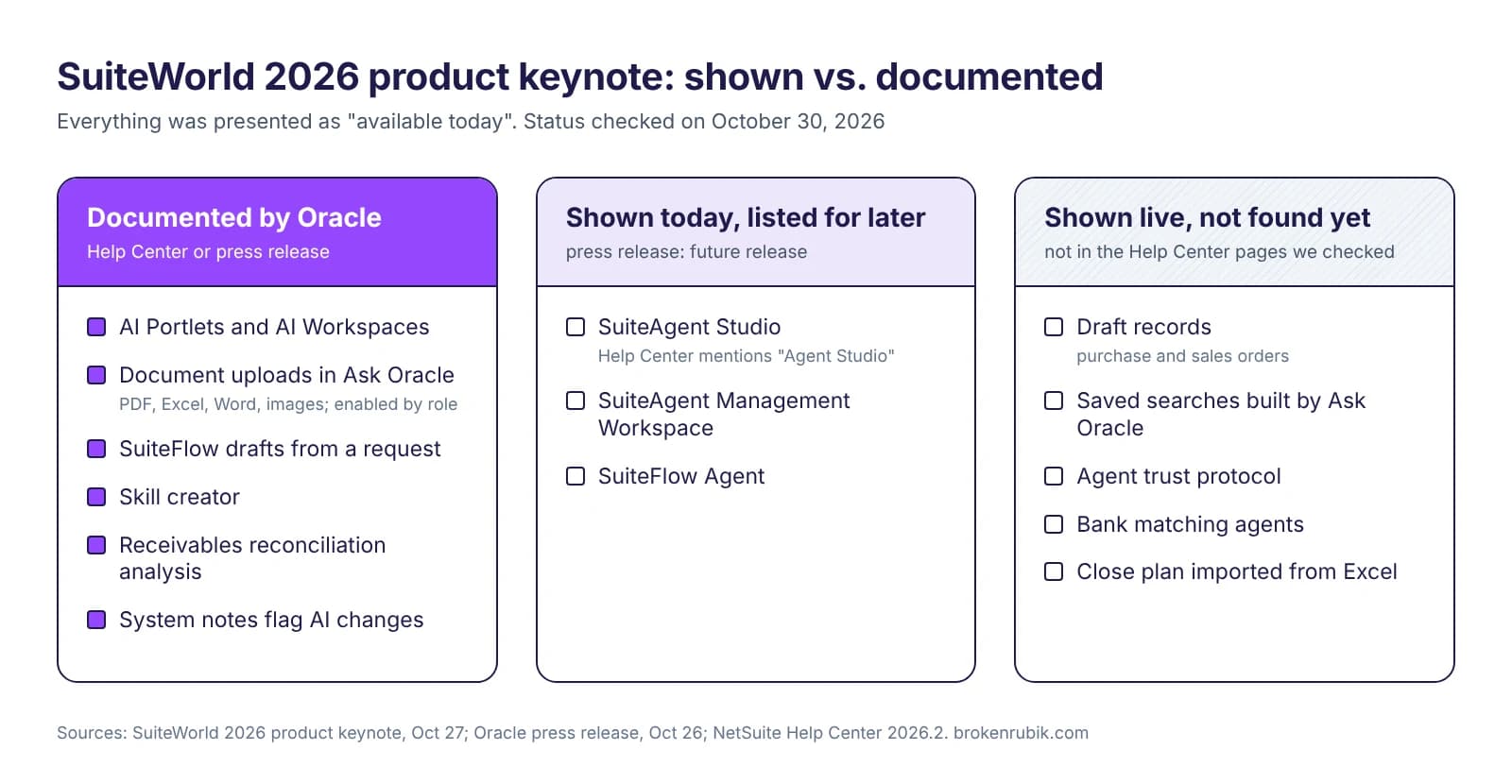
Direct answer: The product keynote showed Ask Oracle, SuiteAgents and the AI close tools working in NetSuite Next, and said all of it is available now. Most of it checks out. Oracle's Help Center for 2026.2 already documents document uploads in Ask Oracle, SuiteFlow workflows drafted from a request, skills you create from a conversation, receivables reconciliation analysis, and system notes that flag changes made by AI. Three things conflict with Oracle's own press release of October 26, which lists them for a future release: SuiteAgent Studio, the SuiteAgent Management Workspace and the SuiteFlow Agent. Draft records and saved searches built by Ask Oracle were shown live, but we did not find them in the Help Center yet.
Checked on October 30, 2026 against the keynote recording, Oracle's press releases of October 26 and the NetSuite Help Center (What's New in Ask Oracle and the 2026.2 release notes).
The keynote in one idea
Chess opened with the questions customers are asking about AI now. They are no longer asking whether it is hype. They ask four things:
- Control: who sees sensitive data, and what agents are allowed to do.
- Trust: whether the numbers come from the right source.
- Scale: whether a pilot will ever turn into something the business runs on.
- Confidence: where to start without a year-long project.
His story about trust stuck: a company used an AI tool to pull its numbers together, and it added British pounds to US dollars. The answer came back fast and was wrong. NetSuite's reply to all four questions was the same through the morning. The AI works inside the roles and permissions you already have, it cites the records and reports behind each answer, and nothing gets changed without someone approving it.
That is the frame. What follows is what was actually shown, sorted by segment.
The adoption numbers
Chess gave the most specific usage figures Oracle has shared so far. They are Oracle's numbers, said on stage:
| Measure | Figure |
|---|---|
| AI Connector Service users at SuiteWorld 2025 | fewer than 1,000 people |
| AI Connector Service, March 2026 | nearly 7,000 businesses a month |
| AI Connector Service, as of the week before SuiteWorld | more than 13,000 businesses have used it |
| Ask Oracle, July 2026 | a few hundred businesses |
| Ask Oracle, September 2026 | more than 2,500 businesses |
| Customers using either | more than 15,000 |
He also listed what was added to the AI Connector Service during the year: the Connector Service Companion, a library of more than 100 ready-made prompts; support for MCP apps, small point-and-click interfaces that run inside the AI conversation; open-source agent skills, including a financial analyst skill; and NetSuite plug-ins in the Claude and ChatGPT directories.
There are three ways to get Ask Oracle, he said: with NetSuite Next, switched on by itself in the NetSuite version you use today, or in a preview account.
Ask Oracle: from questions to records
Patrick's demo went from simple to advanced. In order:
- Suggested prompts that change with the page you are on. Open a customer record and Ask Oracle adds that customer as context.
- Answers that show their source. He asked how this year's net income compared to last year's. Ask Oracle said which report it used (the income statement), which fiscal year and which scope, and opened the report with the same filters so the number could be checked.
- Documents as input. He dropped a marketing budget proposal in PDF and asked whether cash flow could support it. Ask Oracle answered in an "AI canvas" with a chart, the evidence behind it and links to the records. An "explain" icon shows the reasoning step by step, and the underlying data can be downloaded.
- AI Portlets on the dashboard, set up by describing what you want to see. Advanced users can attach context, skills or SuiteAgents to a portlet.
- Draft records. He dropped in a supplier quote and asked for a purchase order. Ask Oracle created a draft PO, not a real one, shown in the normal PO form with the fields to review highlighted. Approval workflows, SuiteScripts and business rules still apply when the draft is submitted. Without a document, he described the PO in words, and Ask Oracle asked which of two vendors to use.
- Saved searches and SuiteFlow workflows built from a request in plain English, such as "overdue invoices over $5,000". Ask Oracle prepares the configuration, and an administrator reviews and approves it. Who may do this is a permission you assign.
- Skills. A skill writes down how your company does a task, in plain English, so Ask Oracle follows the same steps every time. The example was a "new hire equipment" skill for a construction company that compares what a role needs against stock and offers to create a PO for what is missing. Skills can call custom tools built by developers, and they can be shared across teams.
What the Help Center confirms. Oracle's What's New in Ask Oracle page for 2026.2 lists support for uploading PDF, Word, Excel, PowerPoint, image and text files (August), a "workflow manipulation" skill that drafts SuiteFlow workflows from natural-language requests (August, extended to multi-state approval workflows in October), and a "skill creator" that builds private skills from files or a conversation (October). Uploads are enabled per role and need file cabinet access.
What we did not find. Draft records and saved searches built by Ask Oracle do not appear in the Help Center pages we checked. Draft records also show up in other partners' recaps of the keynote. Treat them as real but check them in your own account, as Patrick suggested.
SuiteAgents: how they are built and controlled
Yoav defined an agent as "AI with a purpose", made of a goal, instructions, business context from NetSuite, knowledge such as company policies, skills, tools and guardrails. NetSuite calls the part that runs them the agent harness. His demo turned the new hire equipment skill into an agent that runs on a schedule:
- He described the job to Ask Oracle: check for new hires, work out what each needs, create a PO.
- Ask Oracle proposed an agent that reuses the existing skill, and created it after he approved.
- In SuiteAgent Studio he changed the look-ahead from 7 to 14 days and the schedule from daily to weekly, and set the role the agent runs as, a procurement coordinator.
- In the SuiteAgent Management Workspace he saw who can run it, its triggers, permissions and activity, with a one-click switch to turn it off.
- A month later the agent hit permission errors because the role had been split in two. The workspace flagged it and suggested fixes, and he moved the agent to the new role.
The control model he described is the one admins already know. Ask Oracle uses the permissions of the person in the conversation. SuiteAgents are governed like other NetSuite custom objects: roles decide who can use an agent, and the execution role decides what it can see and do. A new layer, which he called the agent trust protocol, stops for a person's review when an action needs it. System notes record which changes came from Ask Oracle or an agent, and which person or agent started them. The Help Center has documented that last part since August.
For developers, agents are built on SuiteCloud. You create them with the SuiteCloud Development Framework (SDF) and package them as SuiteApps through your usual deployment process. The SuiteCloud Developer Assistant and SuiteCloud Agent Skills, Oracle's skills for AI coding assistants, cover the code side.
The conflict. Yoav said that "everything you just saw is available today". Oracle's press release of October 26 lists SuiteAgent Studio, the SuiteAgent Management Workspace and the SuiteFlow Agent as planned for a future NetSuite release. The Help Center sits in between: its October Ask Oracle notes include a "custom agent configuration" skill that "guides users through creating or editing custom agent configurations in Agent Studio". So Agent Studio exists in some form. Whether your account has it is the question to ask before you plan work around it.
The close: always be closing
Craig, a former controller, showed the end of September in a fictional company that aims for a two-day close. Oracle's customers on stage set the bar: Nature's Emporium, a chain of health food markets, cut its close from 20 days to 3 and uses exception management and Claude for analysis during the month.
What he showed:
- Intelligent close workspace. Every close task, human or agent, in one live view, with two AI Portlets by default: close outlook and close progress. He customized the outlook by typing what he wanted to add.
- Close plan from Excel. He uploaded a close plan kept in a spreadsheet. Ask Oracle mapped it to existing tasks, added missing ones, assigned owners and dates and set dependencies. Tasks done outside NetSuite can still be tracked.
- Bank reconciliation with matching agents. Transactions are matched as they arrive in the bank feed, and mismatches surface the same day. When a match is ambiguous, the agent offers options and a person chooses.
- Account reconciliation inside NetSuite. Any balance sheet account, with an owner, a sign-off and an audit trail. For receivables, Ask Oracle analyzes the balance and drafts the explanation for the preparer to confirm. The Help Center lists an "accounts receivable reconciliation" skill in its October notes.
- Exception management, trained on the account, flagging likely errors as they happen.
- Flux analysis ready on the first day after period end, with Ask Oracle summarizing the close for the CFO.
His acronyms were the takeaway: ABC (always be closing), DEF (detect, explain, fix), GH (go home). The close is NetSuite's strongest case for an AI that sits inside the suite. A standalone close tool only sees what is sent to it. NetSuite also sees the orders, inventory and payments behind each number.
An offer, said on stage. Craig also covered Intelligent Payment Automation, launched with BILL at SuiteWorld 2025. He said hundreds of millions of dollars have gone through it. In a video, the CFO of Helio Health said the finance team saves up to five hours a week. The offer: install Intelligent Payment Automation and buy Bill Capture, and you get 50% off a one-year Bill Capture subscription and 75% off NetSuite's consulting for its implementation. No end date was given. Ask your account manager for the terms in writing.
Operations: two demos with numbers
Allison covered subscriptions, projects and inventory. Two demos are worth retelling, because both ended with a figure.
Projects. A services firm with 75 consultants and about 25 projects running turns on the Project Portfolio AI Portlet and the Project Intelligence skills that come with NetSuite. The portlet flags a high-risk project. Ask Oracle explains the problem: the architect on it has overlapping tasks, and a milestone could slip by two weeks. It ranks replacement candidates by skills, workload and margin impact. The change to the resource assignment happens only after she clicks approve.
Inventory. A distributor with more than 30,000 parts runs the inventory optimization agent in the background. It flags a hydraulic pump whose demand is falling, probably because the supplier released a new model, with about $175,000 of excess stock. Ask Oracle offers three options: consignment, drop ship, or liquidate. It then prepares a markdown plan and a pricing rule, using the consignment and advanced pricing features released this year, and asks for approval first. Then a customer PO arrives by email. With document to record, Ask Oracle creates a draft sales order in about a minute and shows it side by side with the customer's PO.
The customer panel: MCNC
MCNC is a nonprofit technology organization that runs a network reaching all 100 counties of North Carolina. It went on stage with its CFO, Sarah, Laura from finance and Cooper, its NetSuite administrator. They gave the most practical advice of the day: before rollout, the admin tested roles one by one, and they let users switch between the old and new interfaces for two weeks. We turned that into a separate guide, How to Roll Out Ask Oracle, part 5 of this series.
What it means if you run NetSuite today
The written word lags the stage. On Monday the press release said some of this was for a future release. On Tuesday the keynote said it was available today. Monthly releases explain part of the gap: Chess said new capabilities show up every month. For anything you want to plan around, the Help Center and your own account decide, not a slide.
Part 1 of this series already covers the general advice from Monday: role design, approval rules, clean data, and what applies outside the US and Canada. Read it here. Tuesday's keynote adds two things.
Drafts are a new kind of record to govern. On Monday the approvals were about agents and workflows. On Tuesday, Ask Oracle also created draft purchase orders and sales orders from documents, and drafted pricing rules. Each of those needs a named approver. If nobody in your company is named to approve a PO prepared by AI, decide that before you switch on document uploads.
Your own skills are now on the table. SuiteSkills bring Oracle's general procedures (see part 2). Ask Oracle's skill creator lets your users write their own, from a conversation. That is faster to start and harder to govern: someone has to decide which skills get shared, and keep them current when the process changes.
What we would do this week
- Ask about SuiteAgent Studio and the Management Workspace by name if agents are in your plans, and get the answer in writing. The keynote and the press release disagree.
- Name the approvers for AI-created drafts: purchase orders, sales orders, pricing rules, saved searches and workflows.
- Follow the Ask Oracle rollout guide for the rest: role checks, the first questions to ask and the first skill.
Want to see which of this your account already has?
We review your roles for AI, switch on Ask Oracle or the AI Connector Service in a sandbox, and write the first skills with your team.
Talk to our AI integration teamThis is part 4 of our SuiteWorld 2026 series. Part 1 sorts the opening keynote's announcements into what you can use today and what is still a plan. Part 5 is the Ask Oracle rollout guide. For dates and how to watch the keynotes on demand, see our SuiteWorld 2026 guide.
What clients ask before signing
Sources
- SuiteWorld 2026 product keynote, "Ready for Now", Brian Chess and NetSuite leaders, October 27, 2026, on SuiteWorld On Air (free registration)
- Oracle NetSuite, NetSuite Advances Vision for an Autonomous Suite, press release, October 26, 2026 (availability of SuiteAgent Studio, the Management Workspace and the SuiteFlow Agent)
- Oracle NetSuite, What's New in Ask Oracle, NetSuite Help Center (document uploads, workflow, skill creator, agent configuration and receivables reconciliation skills)
- Oracle NetSuite, NetSuite 2026.2 release notes, September 21, 2026 update, NetSuite Help Center (system notes for changes made by AI)
- Oracle NetSuite, Ask Oracle, NetSuite Help Center
Get a NetSuite release audit
New features in the release? We'll tell you what applies to your account and what's safe to turn on.

Sebastian Correa
Co-Founder & CCO
Co-founder and Chief Creative Officer at BrokenRubik with 12+ years of experience in NetSuite consulting and e-commerce development. Specializes in helping businesses optimize their ERP operations and scale their online presence through strategic technology implementations.