
Contents7 sections ↓
Series Roadmap: SuiteWorld 2026
SuiteWorld 2026 Announcements: What You Can Use Today
NetSuite SuiteSkills: What They Are and How to Use Them
Ask Oracle Connectors: NetSuite as an MCP Client, Explained
SuiteWorld 2026 Product Keynote: What Works Today
How to Roll Out Ask Oracle in NetSuite: A Plan in Four Steps
SuiteAgents are AI agents built into NetSuite that watch one industry's numbers, flag what needs attention and propose the next step. Oracle announced six of them at SuiteWorld 2026 on October 26, one for each of six industries.
Direct answer: NetSuite has six industry SuiteAgents: software, product, services, healthcare, construction and nonprofit. Three are available now in NetSuite Next: software (revenue retention, margin and compliance), product (inventory exposure and supply changes) and construction (estimates to job budgets, and payment applications). The services, healthcare and nonprofit agents are planned for a future release, with no date. They run where NetSuite Next runs, which today means the US and Canada, with UK and Australia customers in preview. Users reach them through Ask Oracle, and every action stays within the agent's role and your approvals.
Checked on November 5, 2026 against Oracle's SuiteAgents and Autonomous Suite press releases and the SuiteWorld 2026 keynotes.
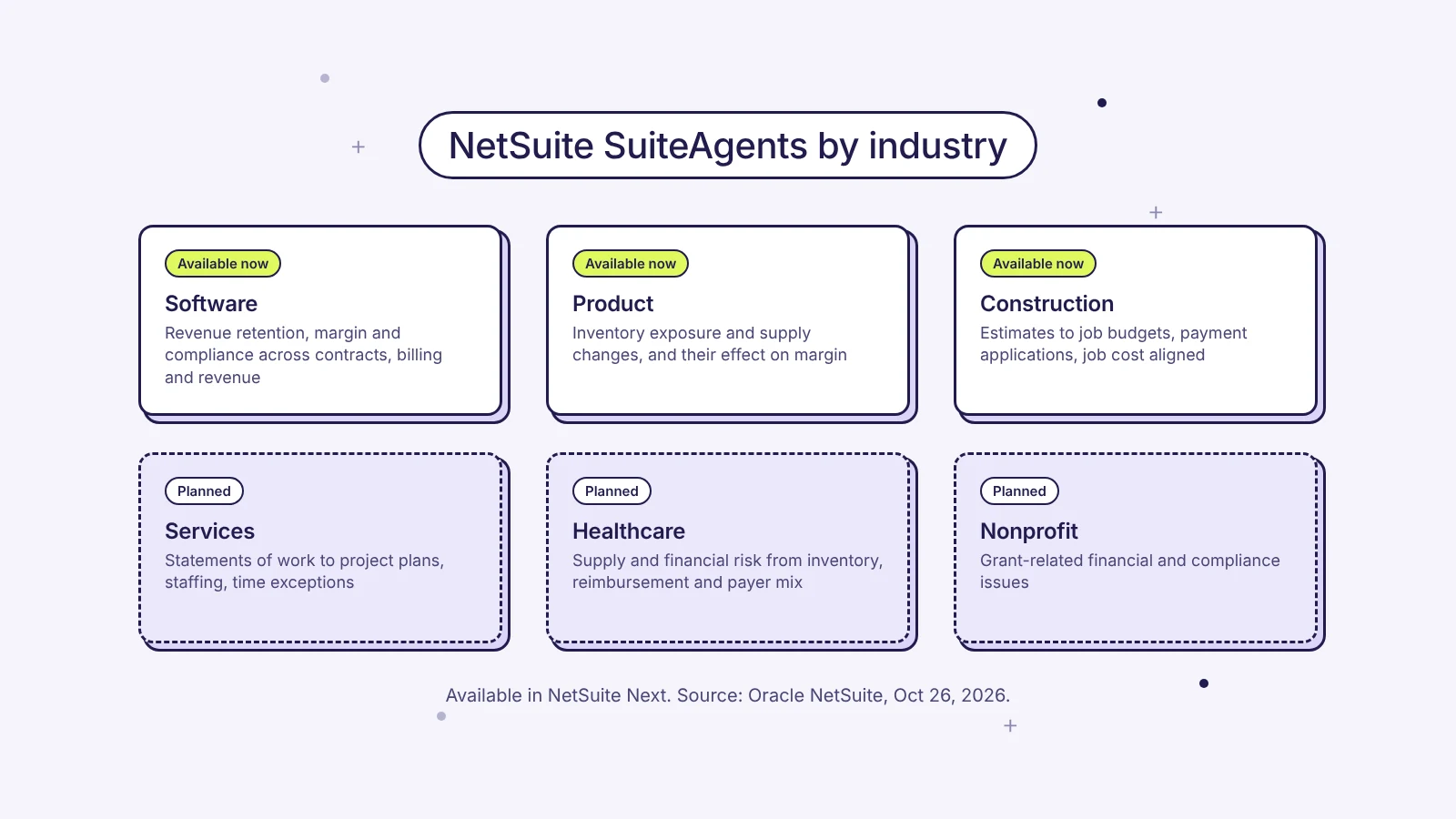
The six SuiteAgents at a glance
| Industry | What the agent does | Status |
|---|---|---|
| Software | Flags conditions that could affect revenue retention, margin, financial health or compliance, and recommends next steps across contracts, revenue recognition, billing and forecasting | Available now |
| Product (wholesale, manufacturing, retail) | Assesses inventory exposure and supply changes, and estimates their effect on inventory efficiency, supply performance and margin | Available now |
| Construction | Turns estimates into job budgets, prepares payment applications from verified progress and approved changes, and keeps job cost, billing and financials aligned | Available now |
| Services | Turns statements of work into editable project plans, reviews staffing capacity, flags time-entry exceptions and assesses project health | Planned |
| Healthcare | Finds supply and financial risks by combining inventory, service-line, reimbursement and payer-mix data | Planned |
| Nonprofit | Finds grant-related financial and compliance issues and suggests operational next steps | Planned |
"Available now" means available in NetSuite Next. Oracle's broader release says "select agents" are available in all NetSuite Next markets, and its SuiteAgents release names these three. The planned agents carry Oracle's usual disclaimer: timing can change.
What each available agent is good for
Software. For subscription businesses, the risk is usually in the gap between contracts, billing and revenue recognition: a renewal billed at the old price, a contract change that never reached the revenue schedule. The agent looks across those records and points at the ones that put retention, margin or compliance at risk. If you already run SuiteBilling and revenue recognition in NetSuite, it has the data it needs. See our guide to NetSuite for SaaS companies.
Product. For companies that hold stock, the agent looks at what a supply change does to inventory and margin: a late purchase order, a supplier price increase, a slow-moving item tying up cash. It gives an estimate of the impact, which is the step that usually happens in a spreadsheet after the fact. It is only as good as your item, location and lead-time data. See our inventory management guide.
Construction. This one does the most actual work. Oracle's construction release describes two agents inside it: an Estimate Import Agent, which turns an estimate into a contract, a schedule of values and a cost-coded budget, and a Payment Application Agent, which prepares AIA-style pay applications from verified progress, approved change orders and retainage terms. A project manager confirms percent complete and billing approves before anything posts. These sit inside Oracle's new NetSuite for Construction solution, which Oracle describes as a limited US rollout first. See NetSuite for construction.
How they differ from SuiteSkills and SuiteAgent Studio
Three names from the same keynote are easy to mix up:
| Name | What it is | Who writes it |
|---|---|---|
| SuiteAgents | Agents for one industry's recurring problems, working inside NetSuite Next | Oracle |
| SuiteSkills | Written procedures that tell an AI assistant how to do a task with NetSuite data, in Ask Oracle, Claude or ChatGPT. See our SuiteSkills explainer | Oracle |
| SuiteAgent Studio | A tool to build your own agents: instructions, tools, triggers and the role they run as | You or your partner |
Industry agents cover what most companies in a vertical share. Studio is for what is specific to yours. Oracle's release does not give Studio a date, although the product keynote demonstrated it as available. We compared the two in part 4 of this series.
What they can and cannot do
- They propose, you approve. Every agent Oracle showed ends in a person reviewing the recommendation or approving the posting. The construction release spells this out for payment applications.
- They work inside a role. Each agent runs with an execution role, the NetSuite role whose permissions it uses. A role that sees too much gives the agent too much. A role that sees too little produces confident answers that are only partly true.
- They read what is in NetSuite. If job costs, contracts or lead times live in spreadsheets, the agent does not see them.
- They leave a trail. Oracle says the SuiteAgent Management Workspace will show each agent's permissions and activity in one place and record agent changes in System Notes, the change history NetSuite keeps on each record. The release does not give that workspace a date.
How to get ready
- Check that you are on NetSuite Next. The agents live there. Our NetSuite Next guide covers eligibility and how admins turn it on.
- Pick one agent and one owner. For a software company, the controller for revenue. For a product company, the person who signs off inventory. The agent's suggestions need someone who acts on them.
- Create the execution role first. Start with read access to the records the agent needs and nothing else. Widen it only when you trust the output.
- Clean the inputs it depends on. Contract dates and pricing for software, lead times and reorder points for product, cost codes and schedules of values for construction.
- Run it next to your current process for one cycle. Compare what the agent flagged with what your team found. Differences usually come from setup, and they are worth finding before anyone relies on it.
- Write down your approval rules. Agents need them as input. If they live in someone's head or an old PDF, the agent cannot follow them.
If your industry is not on the list
Retail and wholesale companies fall under the product agent. Professional services firms will get theirs in a future release. For everything else, the options are SuiteSkills in Ask Oracle or in Claude and ChatGPT, or a custom agent once SuiteAgent Studio reaches your account. We build those on the NetSuite AI Connector Service. If you are about to implement NetSuite, Oracle's new SuiteExpress method also starts with software companies.
Want to try an industry agent on your data first?
We set up the execution role, check the data the agent depends on and run it next to your current process for one cycle, so you know what to trust before rolling it out.
Talk to our AI integration teamThis is part 7 of our SuiteWorld 2026 series. Part 1 sorts everything announced at the keynote into what you can use today and what is still a plan.
What clients ask before signing
Sources
- Oracle NetSuite, NetSuite Puts Industry Expertise to Work with New AI Agents, press release, October 26, 2026
- Oracle NetSuite, NetSuite Advances Vision for an Autonomous Suite, press release, October 26, 2026
- Oracle NetSuite, NetSuite Helps Construction Businesses Protect Margins and Improve Cash Flow, press release, October 26, 2026
- SuiteWorld 2026 opening and product keynotes, October 26 and 27, 2026

Cristina · BrokenRubik
Replies by email within 24 hours

Cristina
Working on something in NetSuite? Tell us in a line what you're trying to do, and a consultant will reply with next steps.

Gustavo Cañete
Co-Founder & Development Director
Co-founder and Development Director at BrokenRubik overseeing technical excellence and development operations. 12+ years of experience leading NetSuite development teams and delivering complex enterprise solutions.