
Contents8 sections ↓
Series Roadmap: SuiteWorld 2026
SuiteWorld 2026 Announcements: What You Can Use Today
NetSuite SuiteSkills: What They Are and How to Use Them
Ask Oracle Connectors: NetSuite as an MCP Client, Explained
SuiteWorld 2026 Product Keynote: What Works Today
How to Roll Out Ask Oracle in NetSuite: A Plan in Four Steps
SuiteExpress is Oracle NetSuite's new way to implement NetSuite with AI agents doing part of the work and consultants overseeing it. Oracle announced it at SuiteWorld 2026 on October 26 and says it can bring implementation time down "to weeks, or even days".
Direct answer: SuiteExpress is an AI toolset and method for implementing and expanding NetSuite. It builds a knowledge base of your business from meeting notes, documents, spreadsheets, recordings and data from your other systems, combines it with Oracle's own product and industry knowledge, and uses agents to capture requirements, prepare and validate data, create and run tests, and guide users after go-live. Consultants oversee the work. Today it is available only to software-industry customers in the US and Canada, as a phased rollout. Oracle plans other industries and countries for 2027. No price has been published.
Checked on November 5, 2026 against Oracle's SuiteExpress press release, CIO.com's coverage and the SuiteWorld 2026 opening keynote.
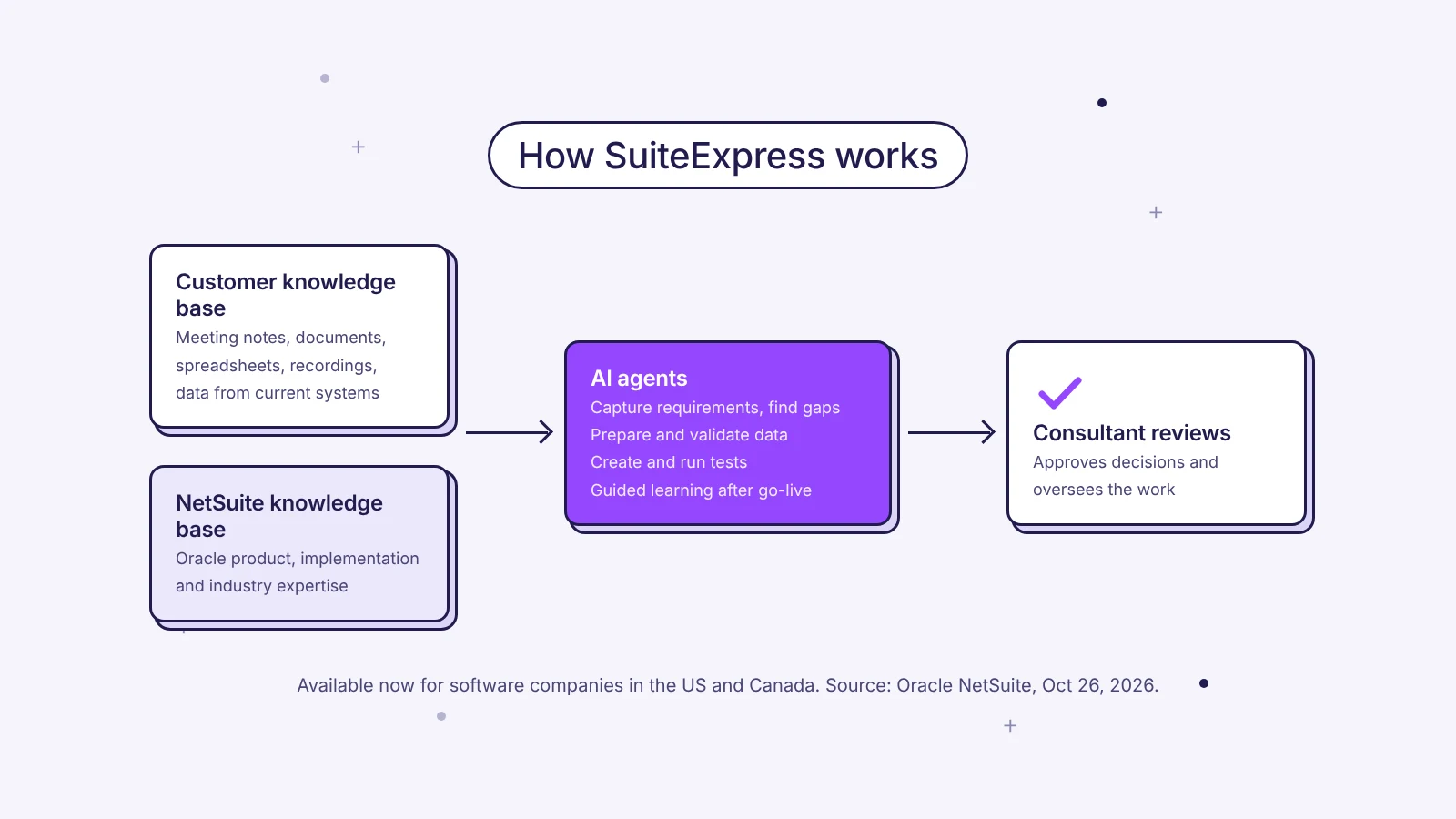
How SuiteExpress works
Oracle describes two knowledge bases that feed the same agents:
| Piece | What goes in | What it is used for |
|---|---|---|
| Customer Knowledge Base | Meeting notes, documents, spreadsheets, recordings and data from the systems you use today | Your requirements, business processes, configuration decisions and the history of what was validated |
| NetSuite Knowledge Base | Oracle's own product, implementation and industry expertise | How NetSuite should be set up for that kind of business |
With both, the AI recommends next steps and carries out implementation tasks. A consultant reviews and decides. That is the same rule Oracle repeated through SuiteWorld for every agent: it proposes, a person approves.
What it automates, step by step
Oracle's release lists seven capabilities. Here is each one next to the phase of a classic project it replaces or shortens. For the classic phases, see our NetSuite implementation guide.
| SuiteExpress capability | Classic phase | What changes |
|---|---|---|
| Accelerated deployment: AI captures requirements and finds gaps | Discovery and design | Requirements come out of your own documents and recordings, not only interviews |
| Mapping solutions to business needs, with consultants guiding key decisions | Design | Recommendations start from Oracle's industry templates |
| Data migration: AI prepares and validates data from existing systems | Data migration | Cleansing and validation get faster; deciding what to migrate is still yours |
| Workflow validation: AI creates and runs tests | Testing | Test scripts are generated, not written by hand |
| Guided Learning: contextual help based on your configuration | Training | Help that matches your setup, not generic documentation |
| Continuous improvement after go-live | Post-go-live support | The knowledge base stays and keeps being used |
| Business expansion, such as a new subsidiary or market | Later projects | The next project starts from what is already known |
The last two rows are the less obvious part. Most implementations lose their context at go-live: the people leave, the decisions live in old emails. Here the knowledge base is meant to stay with the account.
Who can use it today
- Industry: software companies only. That matches NetSuite's first industry agents, which also started with software, product and construction.
- Countries: the US and Canada. CIO.com reports the rollout is phased, with other industries and countries planned for 2027.
- Who runs it: Oracle's release and CIO.com both tie SuiteExpress to NetSuite's own consultants and its Customer Success services. Neither says whether implementation partners will get access, or when.
- Price: not published. Ask whether it changes the services quote, the license, or neither.
One name to watch: the consulting firm Sikich markets a separate offering also called SuiteExpress. The two are unrelated.
What Oracle's customers reported
These are Oracle's customers, quoted by Oracle, not ours.
- Worksmith, which supports about 5,000 retail locations, said on stage that its implementation took 60 days end to end, against the six months it had planned. Its COO, Steve Hehl, says in the release that the company "didn't expect us to get there so quickly".
- Amba Health's financial controller, Jake Leigh, says: "We've never experienced an implementation process like this."
Both are early customers in Oracle's showcase. Neither number is independently verified.
What does not get faster
In the projects we run, the slow weeks are rarely the configuration. They are the decisions, the data and the testing your own people have to do. SuiteExpress helps with the paperwork around all three. It does not make them go away.
- Decisions. An agent can propose a chart of accounts or an approval flow. Someone in finance still has to say yes, and agree with operations first. The faster the tool, the more the calendar depends on how quickly your team decides.
- Data quality. AI can find duplicates and broken references. It cannot tell you which of two customer records is the real one, or whether five years of history are worth moving. See our data migration guide.
- Your team's testing. Generated test scripts help. User acceptance testing is still your people confirming the system does their job. Generated tests check what was configured, not whether it was the right thing to configure.
- Integrations and customization. The release talks about configuration, data and tests. It does not mention integrations with ecommerce, warehouses or CRMs, or custom SuiteScript. In most mid-market projects those are where the time and the budget go. See what drives implementation cost.
- Good inputs. The Customer Knowledge Base is only as good as what goes in. Recordings of meetings where nothing was decided produce requirements nobody agreed to.
What it means if you are planning an implementation
If you are a software company in the US or Canada, ask your NetSuite account manager whether your project qualifies, who the consultants are, and what the quote looks like with and without it. Ask for the scope in writing: which phases SuiteExpress covers, and who builds integrations and customizations.
If you are in another industry or country, it is not available to you yet. The useful part is still the method: write down your processes, approval rules and decisions before the project starts. That is exactly what SuiteExpress turns into a knowledge base, and any implementation team can use it.
If you already run NetSuite, watch the "continuous improvement" and "business expansion" parts. Oracle presents SuiteExpress as something that stays after go-live, for new subsidiaries and new markets, not only a way to start.
Where we stand
We implement NetSuite, so this announcement is about our work too. Shorter implementations are good for customers, and AI that turns meeting notes into requirements and generates test scripts is the kind of help we already use in our own projects. What we would not expect is for the weeks spent on decisions, data and integrations to disappear. When you compare quotes, compare what each team does in those weeks.
Planning a NetSuite implementation for 2027?
Tell us your entities, users, modules and the systems you need to connect. We will show you which phases AI can shorten in your case and where the time really goes.
Scope a NetSuite implementationThis is part 6 of our SuiteWorld 2026 series. Part 1 sorts everything announced at the keynote into what you can use today and what is still a plan.
What clients ask before signing
Sources
- Oracle NetSuite, NetSuite Introduces SuiteExpress to Accelerate ERP Implementation and Continuous Improvement with AI, press release, October 26, 2026
- CIO.com, NetSuite launches SuiteExpress to expedite implementation and optimization of ERP, October 2026 (phased rollout, 2027 expansion)
- SuiteWorld 2026 opening keynote, October 26, 2026 (Worksmith's 60-day implementation)

Gustavo · BrokenRubik
Replies by email within 24 hours

Gustavo
Planning a NetSuite rollout? Tell us your team size and target go-live, and we'll reply with how we'd scope it.

Joaquin Vigna
Co-Founder & CTO
Co-founder and Chief Technology Officer at BrokenRubik with 12+ years of experience in software architecture and NetSuite development. Leads technical strategy, innovation initiatives, and ensures delivery excellence across all projects.