
Contents8 sections ↓
What composable commerce is
Composable commerce is an architecture where you assemble your commerce stack from independent, specialized services instead of relying on a single all-in-one platform. Each component — storefront, search, checkout, CMS, payments, OMS — is a separate service that communicates with the others through APIs.
The idea is simple: instead of buying one platform that does everything (and compromises on most of it), you pick the best tool for each function and wire them together.
A composable stack might look like this:
- Storefront: A headless frontend built with Next.js or a hosted solution like Shogun
- Search and merchandising: Algolia or Constructor
- CMS: Contentful or Sanity for content management
- Checkout: Bold Commerce or a custom checkout flow
- Payments: Stripe or Adyen
- Order management and ERP: NetSuite
- PIM: Akeneo or Salsify for product information
Each service handles one thing well and exposes APIs for the others to consume.
MACH architecture: the technical foundation
Composable commerce is built on MACH principles:
Microservices. Each business function runs as an independent service. Search doesn't know about checkout. Payments don't know about inventory. Each service can be developed, deployed, and scaled independently.
API-first. Every service communicates through APIs — typically REST or GraphQL. This is what allows you to swap components without rebuilding the entire stack. If your current search solution underperforms, you replace it with another API-compatible service.
Cloud-native. Services run on cloud infrastructure with automatic scaling, global distribution, and managed operations. No on-premise servers to maintain.
Headless. The frontend (what customers see) is decoupled from the backend (business logic, data). You can build any customer experience — web, mobile app, kiosk, voice — without changing your backend services.
Together, these principles give you maximum flexibility. In theory, any component can be swapped without affecting the others. In practice, it's more nuanced than that.
Composable vs. monolithic: the real trade-offs
The composable commerce conversation is often framed as "modern and flexible" vs. "legacy and rigid." That framing is misleading. Both architectures have genuine advantages.
What monolithic platforms do well
Shopify, BigCommerce, SuiteCommerce — these are monolithic platforms. One vendor provides the storefront, checkout, payments, basic CMS, and often order management in a single package.
Their advantages are real:
- Speed to market. You can launch a functional store in weeks, not months. No API architecture to design, no services to wire together.
- Operational simplicity. One vendor, one support team, one set of documentation. When something breaks, you know who to call.
- Lower total cost of ownership for most companies. The hidden cost of composable is the integration layer — maintaining API connections between 6-10 separate services requires ongoing development effort.
- Built-in features that work together. Promotions interact with checkout correctly. Inventory connects to the storefront natively. You don't have to build these connections yourself.
What composable does better
- Best-of-breed capability. Your search can be powered by a specialized engine that understands natural language and visual merchandising — capabilities a monolithic platform's built-in search may not match.
- Frontend flexibility. You can build any customer experience without platform constraints. Progressive web apps, native mobile apps, in-store kiosks — all consuming the same backend APIs.
- Independent scaling. Your search service can scale independently during a product launch without scaling your entire stack.
- Vendor independence. If a component vendor raises prices, degrades quality, or gets acquired, you replace that service without rebuilding your stack.
Who actually benefits from composable
Composable commerce makes sense for companies that meet most of these criteria:
- Significant annual revenue. The added complexity and cost of composable needs to be justified by scale — most companies adopting it are well into eight figures.
- Engineering team capable of managing API integrations. If you rely entirely on external agencies for development, composable becomes expensive fast.
- Specific performance requirements that monolithic platforms can't meet. Sub-200ms search responses, custom checkout flows, unique merchandising logic.
- Multiple customer-facing experiences. If you need web, mobile app, B2B portal, and in-store — each with a different UI but sharing the same backend — composable's headless architecture pays for itself.
- Willingness to invest in integration infrastructure. The API connections between services need monitoring, error handling, and maintenance. This isn't a one-time setup cost.
For everyone else — and that's most mid-market companies — a well-implemented monolithic platform with strategic integrations is simpler, cheaper, and fast enough.
NetSuite in a composable stack
In a composable architecture, NetSuite typically serves as the operational backbone — the system of record for inventory, orders, financials, and customer data. The storefront and customer-facing services are separate, but they all ultimately flow data into and out of NetSuite.
Why NetSuite as the core
NetSuite handles the parts of commerce that aren't customer-facing but are operationally critical:
- Order management. All orders — regardless of which storefront or channel generated them — are managed, fulfilled, and tracked in NetSuite.
- Inventory. Real-time inventory across all warehouses, stores, and fulfillment locations. ATP calculations happen against one inventory dataset.
- Financials. Revenue recognition, COGS, tax, and payment reconciliation — all automated in NetSuite's financial modules.
- Customer records. One customer profile with full transaction history, regardless of which frontend the customer used.
How a composable stack connects to NetSuite
The integration layer between your composable services and NetSuite typically works through:
Middleware platforms. Celigo or Boomi orchestrate data flows between services and NetSuite. Order data from the checkout service flows through middleware into NetSuite. Inventory updates from NetSuite flow through middleware to the storefront and search services.
Direct API integration. NetSuite's REST and SOAP APIs allow services to query and update NetSuite directly. Custom SuiteScript endpoints can expose specific business logic to external services.
Event-driven architecture. Using SuiteScript (User Event Scripts or Workflow Actions), NetSuite can fire outbound notifications when records change — order created, inventory updated, customer modified. Middleware like Celigo can also listen for these changes, reducing the need for scheduled batch syncs.
Example composable architecture with NetSuite
Customer → Headless storefront (Next.js)
              ↓
         Search (Algolia) ← Product data ← NetSuite (via PIM)
              ↓
         Checkout (custom) → Payment (Stripe)
              ↓
         Order → Celigo → NetSuite (order management)
              ↓
         NetSuite → Fulfillment → Shipping (ShipStation)
              ↓
         NetSuite → Financial posting → GL
Each arrow is an API call or event that needs to work reliably, at scale, under load. This is where the real cost of composable lives — not in the individual services, but in the connections between them.
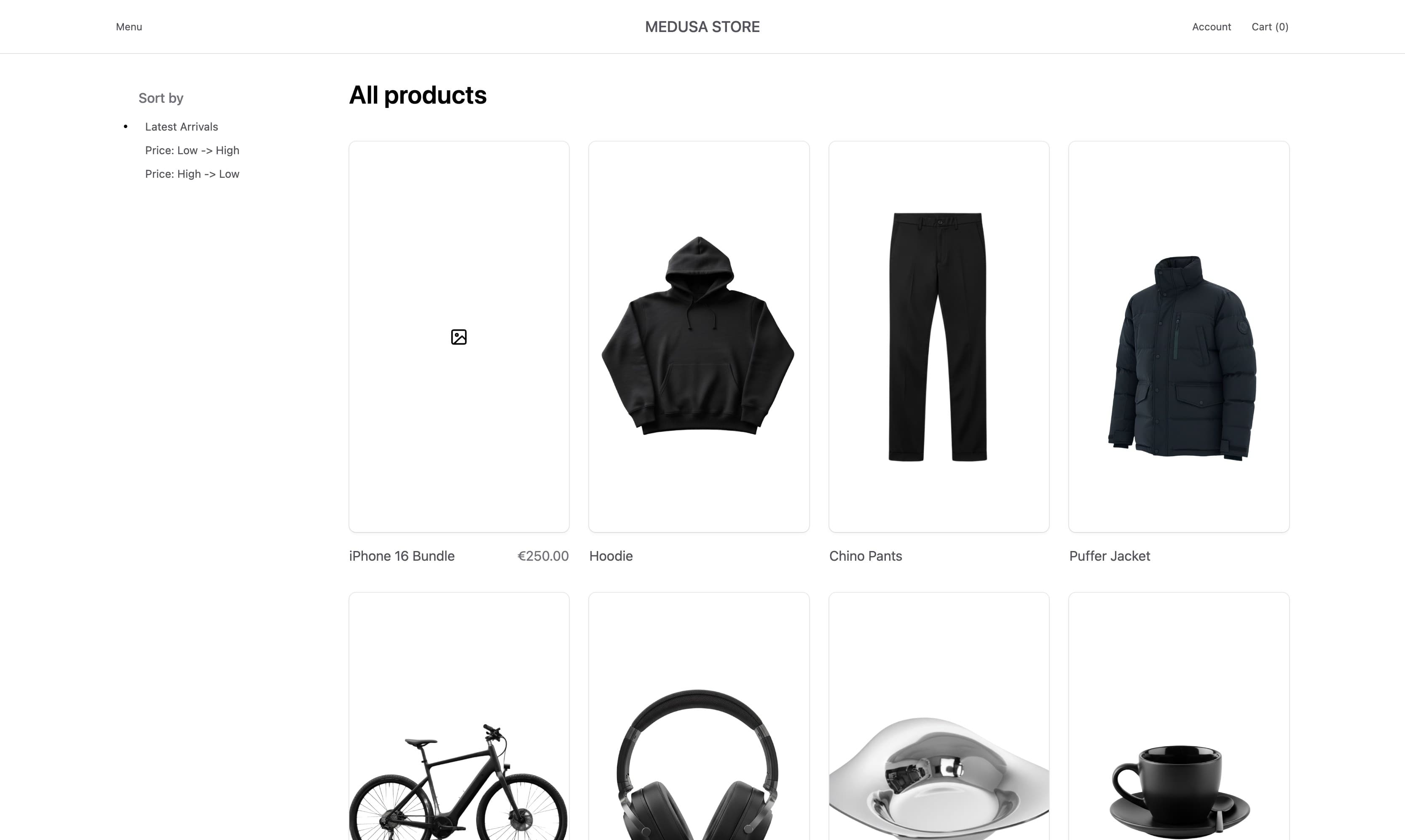
Composable with NetSuite, without the guesswork
A modern React storefront on Medusa or Shopify, kept in two-way sync with NetSuite through Gemstone. Working example in your sandbox in 48 hours.
Explore headless with NetSuiteThe hidden costs of composable
Composable commerce vendors pitch flexibility and best-of-breed capability. What they mention less often:
Integration maintenance
Every API connection between services needs monitoring. APIs change. Vendors deprecate endpoints. Rate limits shift. A composable stack with 8 services has dozens of API integrations to maintain. Budget ongoing development time for this.
Vendor management
Instead of one vendor relationship (Shopify, BigCommerce), you have 6-10. Each has its own contract, pricing changes, support team, roadmap, and deprecation timeline. Your team needs to track all of them.
Performance debugging
When the checkout is slow, is it the checkout service? The payment provider? The API call to NetSuite for inventory verification? The CDN serving the storefront? In a monolithic platform, you look in one place. In a composable stack, you trace through multiple services to find the bottleneck.
Data consistency
With data distributed across multiple services, keeping it consistent requires discipline. What happens when the CMS has a product description that doesn't match what's in NetSuite? When the search index is out of date with the latest inventory? These are solvable problems, but they require deliberate architecture.
Total cost
A realistic composable stack costs more than a monolithic alternative. Not just the individual SaaS subscriptions, but the engineering time to build and maintain the integration layer. For a mid-market company, the total cost difference can be significant.
| Cost category | Monolithic (Shopify + NetSuite) | Composable stack |
|---|---|---|
| Platform subscriptions | 1-2 platforms | 6-10 services |
| Integration | 1 connector (Celigo) | Multiple API integrations |
| Development | Platform themes + apps | Custom frontend + API layer |
| Ongoing maintenance | Integration monitoring | Full stack operations |
| Team required | 1-2 developers | 3-5+ engineers |
When to go composable (and when not to)
Go composable if:
- Your current platform is genuinely limiting growth — not just inconvenient, but blocking revenue
- You have the engineering team to own and operate a distributed system
- You need customer experiences that monolithic platforms cannot deliver
- You're at a scale where best-of-breed components create measurable competitive advantage
- You've already optimized your monolithic setup and hit its ceiling
Stay monolithic if:
- Your platform constraints can be solved with apps, themes, or better implementation
- Your engineering team is small or outsourced
- Your competitive advantage is in product, brand, or operations — not technology
- You're growing fast and need to move quickly without architectural complexity
- Your budget is better spent on marketing, inventory, or hiring than infrastructure
The hybrid path
Most mid-market companies land somewhere in between. They run a monolithic storefront (SuiteCommerce or Shopify) with NetSuite as the ERP, and selectively adopt composable components where they add clear value:
- Search: Algolia for better search and merchandising than the platform's built-in search
- CMS: Contentful for richer content management than the platform offers
- Payments: Stripe for more payment flexibility
This gives you some best-of-breed advantage without the full complexity of a composable architecture.
How BrokenRubik helps with composable commerce
We work with mid-market companies that are evaluating composable architecture or building composable stacks with NetSuite as the operational core.
Architecture assessment. We evaluate whether composable actually makes sense for your business, or whether a better-implemented monolithic platform solves your problems at lower cost. We don't push composable for its own sake.
Integration design and implementation. When composable is the right call, we design the integration layer between your frontend services and NetSuite using Celigo, custom APIs, or n8n for event-driven workflows.
NetSuite as the operational backbone. Configuring NetSuite's order management, inventory, and financials to serve as the system of record in a composable stack — including the API endpoints and SuiteScript customizations that external services need to interact with.
Ongoing operations. Monitoring integrations, debugging cross-service issues, and maintaining the connections between your composable components and NetSuite.
If you're considering composable commerce and want an honest assessment of whether it's right for your business, let's talk.
Frequently Asked Questions
What clients ask before signing
Get help with your NetSuite setup
Tell us which feature or process isn't working the way you need. We'll scope a fix — usually days, not months.

BrokenRubik
NetSuite Development Agency
Independent NetSuite consultancy specializing in NetSuite ERP, SuiteCommerce development, and enterprise integrations. 100+ companies served since 2017, from mid-market to enterprise OneWorld deployments.